Don Aurelio was handed a sheet of paper with three handwritten letters on it: EKG. He needed it before gallbladder surgery, and the first thing he asked at the front desk was whether there would be a needle involved or whether he had to skip breakfast. Neither. The electrocardiogram is one of the simplest tests in medicine and also one of the least explained: people hear the name, see the squiggly lines on paper and walk out without knowing what was being looked for or what turned up. This guide tries to fill that gap.
Your heart has wiring too
Every heartbeat begins with a tiny electrical signal that starts at the top of the heart and travels downward, telling each chamber to squeeze in the right order. An electrocardiogram doesn't measure how strong the heart is, and it doesn't take pictures of it. It listens to that current through the skin and draws it as a line that rises and falls.
Those waves are named with letters (P, QRS, T), and each one matches a moment in the beat. By reading them, the clinic's medical team can see three basic things:
- Rhythm: whether the beats arrive evenly or out of order.
- Rate: whether the heart is running too fast, too slow or within an expected range.
- The signal's path: whether the current is delayed, rerouted or leaves traces of old damage in some area of the muscle.
With ten adhesive electrodes, the machine builds twelve different "views" of the same heartbeat, as if the heart were being watched from twelve angles around the chest. That's why a recording lasting only a few seconds carries so much information.
What happens on the exam table, step by step
Knowing what's coming takes away most of the nerves, and nerves, oddly enough, can show up on the tracing too.
- You'll be asked to uncover your chest, ankles and wrists. A top with pants or a skirt is far more practical than a one-piece dress.
- You lie on your back. If there's a lot of chest hair, a small patch may be trimmed so the electrodes stick properly.
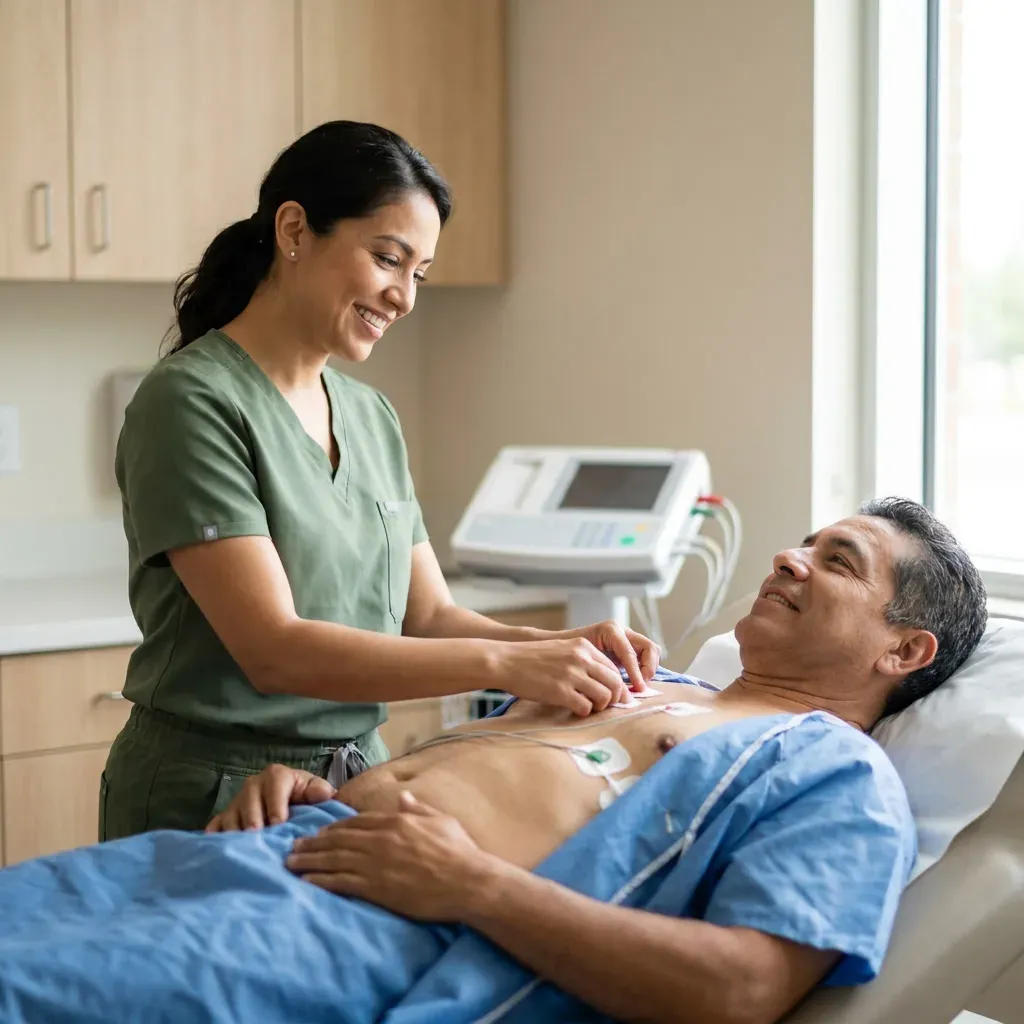
- The ten stickers go on: six across the chest and one on each arm and leg. They feel cold, and that's it.
- While it records, stay still, don't talk and breathe normally. Shivering from a chilly room, crossing your legs or laughing all add "noise" to the line.
- The stickers come off and you're done. According to the clinic's electrocardiogram page, the whole process takes under ten minutes.
There's no fasting and nothing to stop beforehand. What does help: skip lotion or oil on your chest that day and bring a written list of your medications, because some of them change how the tracing looks.
Why it gets ordered: common reasons and what each one looks for
Not everyone needs an electrocardiogram at every checkup. It's ordered when there's a specific question to answer. These are the most frequent situations:
| Reason for ordering it | What the tracing is checked for |
|---|---|
| Palpitations, a beat that "skips" or suddenly races | Arrhythmias: irregular, very fast or very slow beats |
| A bad dizzy spell or a fainting episode that has passed | Slow rhythms or signals that get blocked along the way |
| Several years of elevated blood pressure | Thickening of the muscle from the extra work of pumping |
| Diabetes, smoking or a family history of heart attack | Traces of an old heart attack or reduced blood flow to the heart |
| Before surgery, a work exam or a sport | A baseline tracing to compare against later |
| Medications that can affect the rhythm | Changes in the timing between one wave and the next |
For men with risk factors, the clinic's men's health checkup includes the electrocardiogram alongside blood pressure and lab work. For people already in follow-up for diabetes, high blood pressure and cholesterol, it helps show whether those conditions are starting to leave a mark on the heart. And for teenagers, when the school or sports physical picks up a murmur or high blood pressure, one may be needed before the form gets signed.
What an electrocardiogram can't tell you
This is where the most common misunderstanding lives. A normal tracing is good news, but it has clear limits:
- It's a snapshot of a few seconds. If your palpitations show up twice a week and happen not to appear while you're on the table, the test can come back normal. Writing down when they happen, how long they last and what you were doing helps a great deal.
- At rest, narrowed arteries may go unnoticed. A heart with poor blood supply sometimes only "complains" during exertion. That's why a normal electrocardiogram doesn't fully rule out a coronary artery problem.
- It doesn't measure the valves or pumping strength. Other tests handle that, such as the echocardiogram, which is an ultrasound of the heart.
When the result or the symptoms leave open questions, general medical guidance is to add other tests: a portable monitor that records the rhythm over several days, a treadmill stress test or an echocardiogram, as part of a specialized evaluation. The clinic's medical team will explain which one makes sense for you and why.
"Mine came back abnormal": stay calm before drawing conclusions
A line with changes doesn't always mean disease. Electrode placement, the nerves of the moment, body build, certain medications and even physical training all play a part: very active people often have a resting pulse slower than expected, and that isn't a problem.
That's why a tracing is never read on its own. It's interpreted together with your symptoms, your blood pressure, your blood tests and, if one exists, a previous electrocardiogram. That last point is worth a lot: if you ever had one done somewhere else, ask for a copy and keep it. Comparing two tracings taken years apart says far more than looking at one in isolation.
If treatment is recommended based on the result, the prescription is sent electronically to the pharmacy you choose. And if you already take heart or blood pressure medication, don't stop it or change the dose on your own because of a result: talk with the medical team before changing anything.
When there's no time for a test: call 911
A scheduled electrocardiogram is for questions that can wait a few minutes in a waiting room. In some situations you should not head to a clinic or drive yourself anywhere:
- Severe or crushing chest pain, especially if it spreads to the arm, back or jaw, with a cold sweat.
- Sudden shortness of breath.
- A drooping face on one side, a weak arm or slurred speech.
In any of those cases, call 911. Emergency crews can run an electrocardiogram inside the ambulance and alert the hospital before you arrive.
For your visit to Clínica Hispana Corazón y Vida
The electrocardiogram is one of the clinic's services: it's done during the same visit, without an appointment, and the result is explained to you in Spanish. To get the cleanest tracing possible:
- Wear two-piece clothing and no lotion on your chest.
- Bring your medication list, including vitamins and natural products.
- If you have an earlier electrocardiogram or the order from your surgeon's office, bring those along.
- If your symptoms come and go, jot down on your phone the date, the time and what you felt.
We're at 918 W Southmore Ave, Suite 180, in Pasadena, a short drive for many families in South Houston and Deer Park. If you've been asked for an EKG and aren't sure whether you need to do anything first, call (832) 930-5551: once we know why it was ordered, the clinic's medical team will tell you how to come prepared.
Need medical attention?
We're here to help. Call now to schedule your appointment or visit our clinic without an appointment.
Call now: +1 (832) 930-5551